Yet, emission targets alone have failed to drive 1.5°C-aligned shifts in automakers’ operations and business activities along the value chain. Introducing transition-specific alignment targets (‘transition targets’) alongside emission targets would refocus target-setting to better guide, incentivise and track decarbonisation efforts along the value chain.
Emission targets fall critically short in reflecting automakers’ transitions
Recent analyses like the Corporate Climate Responsibility Monitor show systemic limitations in current target-setting practices centred around emission targets. Two conceptual limitations are especially relevant for automakers.
First, emission targets depend on emissions accounting and inventories that are often incomplete or inaccurate. This undermines the meaning of automakers’ emission targets because they may (i) exclude certain emission sources, (ii) use faulty assumptions about vehicles’ use-phase emissions, (iii) lack reliable data on emissions from purchased materials, and (iv) depend on carbon credits to claim reductions.
Second, emission targets often fail to adequately reflect innovation and can favour established automakers. Innovative newcomers might see interim increase in emissions as they scale up, even though their climate solutions may be critically relevant for achieving a 1.5°C-aligned decarbonisation in the sector.
Together, these limitations make standalone emission targets inadequate to guide automakers’ climate strategies. This calls for a timely, science-based improvement to current target-setting, complementing it with the introduction of transition targets.
Introducing transition targets to guide sector-specific transitions
Corporate target-setting should first and foremost ensure that targets guide, incentivise and track companies along key sectoral transitions. Unlike emission targets, transition targets are designed to systematically track progress toward 1.5°C-aligned transitions across the value chain within a given sector.
For automakers, this means shifting upstream procurement to increase the use of near-zero steel, near-zero aluminium and low-carbon batteries. Consequently, transition targets place greater emphasis on near-term actions and sector-specific transitions for automakers.
Introducing transition targets alongside emission targets enables stakeholders to identify and reward business changes aligned with 1.5°C pathways. As a result, investors, regulators, courts and civil society can better distinguish genuine leadership from greenwashing and effectively push for real transitions rather than accounting-based manoeuvres.
From theory to practice: operationalising transition targets
As a first step in operationalising transition targets, identifying key transitions in a sector requires a nuanced understanding of current and future emission sources. For automotive manufacturers, vehicles’ use-phase emissions currently account for the majority of total emissions, Beyond this, the largest remaining sources stem from upstream purchases of steel, aluminium and batteries, which are becoming increasingly important as the sector decarbonises (Figure 1)
The second step is to identify actionable and transparent metrics for specific targets. For automakers’ upstream activities, these could be the share of near-zero emission steel procured, the share of near-zero aluminium procured and the GHG intensity per kWh battery capacity.
The third and final step is to develop 1.5°C-aligned benchmarks for each of these target metrics. This can involve reviewing existing literature and conducting new analyses where gaps remain.
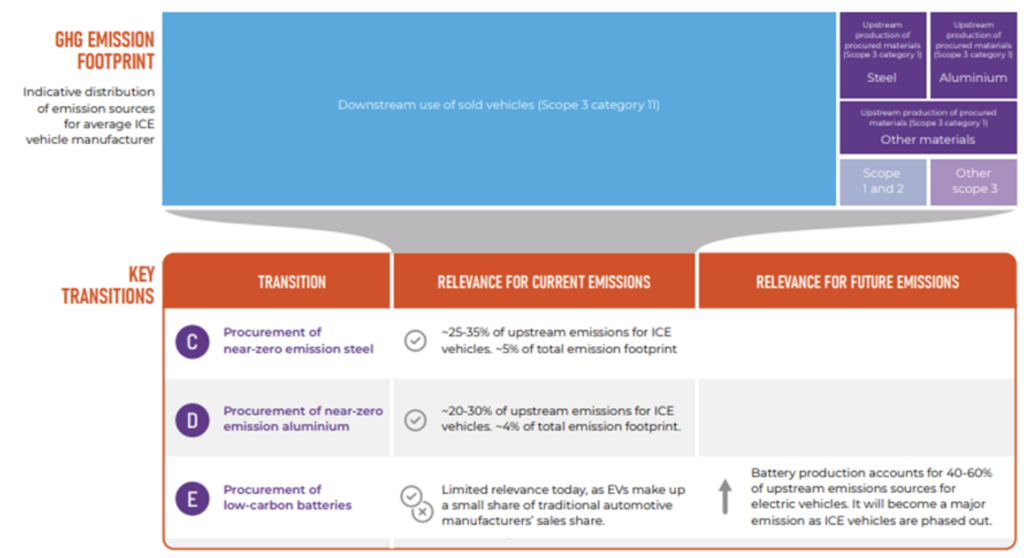
Figure 1: Overview of emission sources and key transitions along the automakers’ upstream value chain. Source: NewClimate, 2025.
Going forward
For automakers, several initiatives are piloting transition-target methods, including the World Economic Forum’s First Mover Coalition and the Climate Group’s SteelZero. As of 2026, for example, Ford, GM, Volvo Cars and Volvo Group have committed, via the First Movers Coalition, to purchase 10% of near-zero steel by 2030. These emerging efforts can provide valuable lessons for broader adoption.
Against this backdrop, the standard-setting cycles by accountability initiatives in 2026 create a key opportunity to introduce transition targets for standard setters. Most prominently, the SBTi plans to publish its Automotive Sector Net-Zero Standard in 2026 or shortly thereafter. A draft released in February 2026 already proposes transition‑target options for consultation, including metrics such as the share of zero‑/near‑zero‑emission vehicle sales and targets for priority purchased commodities.
Automakers therefore have a timely opportunity to revisit their emission-only target-setting approaches and set transparent, actionable transition targets that better drive the sector’s decarbonisation.